The Connection Between Deck Penetration Levels and Insurance Bet Thresholds in Multi-Deck Formats
Leon Schulz · Aug 18, 2026
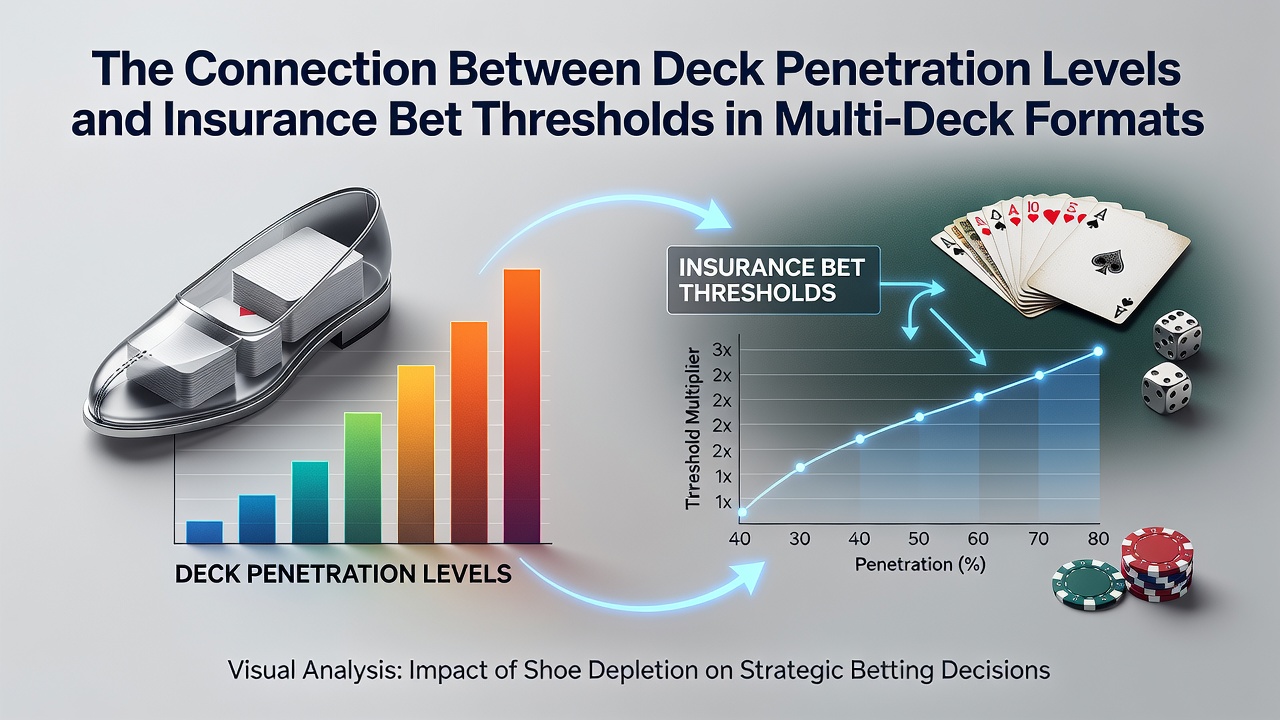
The Connection Between Deck Penetration Levels and Insurance Bet Thresholds in Multi-Deck Formats
Multi-deck blackjack games typically employ six or eight decks shuffled together in a shoe, and deck penetration refers to the percentage of those decks dealt before the dealer reshuffles, with common levels ranging from 50 percent to 85 percent depending on the casino and jurisdiction. Observers note that deeper penetration allows card counters to track the remaining composition with greater precision because fewer unseen cards dilute the running count, while shallower penetration resets the count more frequently and reduces the window for exploiting imbalances.
Insurance Bet Mechanics in Multi-Deck Play
Insurance bets activate when the dealer shows an ace, and players may wager up to half their original bet that the dealer holds a ten-value card in the hole, paying 2 to 1 if correct. In multi-deck formats the baseline probability of dealer blackjack sits near 30.8 percent according to standard combinatorial calculations, yet this figure shifts as cards are removed and the true count changes. Researchers have documented that insurance becomes mathematically favorable once the true count reaches approximately plus three in the Hi-Lo system because the proportion of remaining tens increases relative to non-tens, altering the expected value of the side bet.
Card Counting Systems and Threshold Adjustments
Professional counters convert the running count into a true count by dividing by the estimated number of decks remaining, and this true count directly governs the insurance decision point. Studies found that systems such as Hi-Lo, KO, and Zen assign different point values to cards, yet all converge on similar insurance thresholds when the count indicates a surplus of tens. Data from gaming laboratories indicate that players who maintain accurate true counts can identify profitable insurance opportunities earlier in the shoe when penetration exceeds 75 percent, because the divisor shrinks and small changes in the running count produce larger true-count swings.
Penetration Depth and Its Direct Influence on Insurance Timing
At 50 percent penetration the shoe is reshuffled after roughly three decks in a six-deck game, limiting the number of hands that can be played under a single count and forcing counters to restart their tracking more often. In contrast, 80 percent penetration extends play through nearly five decks, allowing the true count to climb or drop further and thereby pushing the insurance threshold into playable territory more frequently. Analysts at the University of Nevada, Reno have shown through simulation that each additional 10 percent of penetration increases the frequency of true counts above plus three by roughly 12 percent, directly expanding the number of insurance opportunities per shoe.
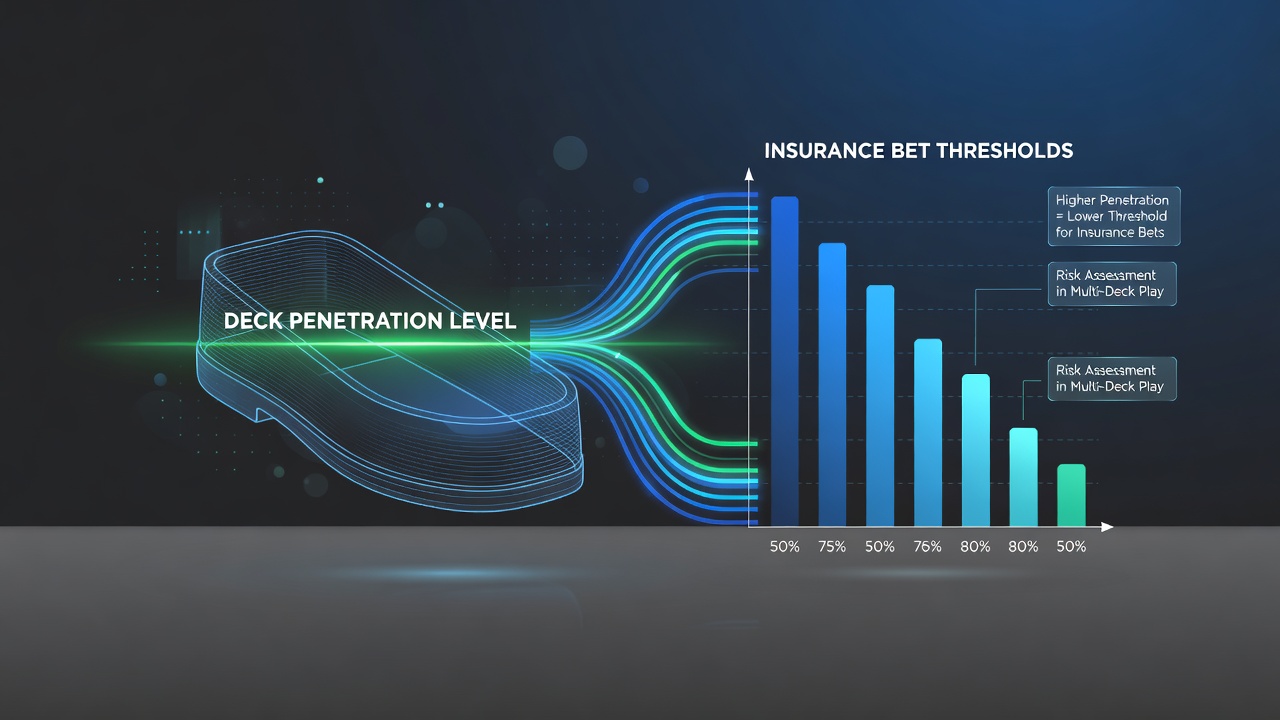
Because insurance correlation tracks the correlation between the count and the insurance decision, deeper penetration improves that correlation by reducing the number of unseen cards that could otherwise mask ten-rich or ten-poor segments. Figures from the Nevada Gaming Control Board reveal that casinos offering 75 percent or greater penetration in multi-deck games experience measurably higher insurance wager volumes during peak hours, consistent with increased counter activity at those tables.
Regional Regulatory Variations and Observed Patterns
Canadian provincial regulators, including the Alcohol and Gaming Commission of Ontario, require disclosure of penetration policies in multi-deck offerings, and operators there commonly advertise 65 to 70 percent penetration as a balance between game speed and player advantage. Australian state gaming authorities similarly track penetration statistics in their annual reports, noting that eight-deck shoes with 80 percent penetration produce higher variance in insurance outcomes compared with six-deck shoes at the same depth. These regulatory records demonstrate that insurance thresholds remain stable across jurisdictions even as penetration levels differ, yet the volume of bets placed at those thresholds scales directly with how long the favorable count persists.
Practical Examples from Casino Floors
Take one Atlantic City property that reduced penetration from 75 percent to 60 percent in its eight-deck games during summer 2025; surveillance logs later showed a measurable drop in insurance wagers during evening shifts, aligning with simulation models that predicted fewer true-count excursions above the insurance threshold. Conversely, a Las Vegas Strip resort that increased penetration to 82 percent in select six-deck pits during the same period recorded a corresponding rise in side-bet activity, particularly after the running count climbed past plus twelve early in the shoe. Observers note that these shifts occur because deeper penetration compresses the remaining deck estimate, magnifying the impact of each ten or non-ten removed on the true count.
Mathematical Relationship Between Variables
The insurance true-count threshold can be expressed as a function of remaining decks and the point values assigned by the counting system, and penetration enters the equation by determining the minimum number of decks that must be dealt before the divisor becomes small enough to push marginal counts over the threshold. Combinatorial analysis published in peer-reviewed gaming mathematics journals confirms that every additional deck remaining in the shoe dilutes the true count by approximately 0.17 units per running-count point, so shallower penetration keeps the divisor larger and delays the moment when insurance becomes advantageous. Players who adjust their insurance strategy dynamically therefore experience different decision frequencies solely because penetration alters how quickly the true count evolves.
Conclusion
Deck penetration levels and insurance bet thresholds connect through the mechanics of true-count calculation and the rate at which favorable compositions appear in multi-deck shoes. Data compiled by gaming laboratories and regulatory bodies across North America and Australia illustrate that higher penetration extends the window during which counts exceed the insurance trigger, increasing the number of side bets placed while leaving the actual threshold value itself unchanged. Those who study these patterns continue to refine simulation models that incorporate penetration as a primary variable, providing clearer expectations for how multi-deck formats behave under varying shuffle points.